
The Squirrel Question
Resurging Squirrels and the River Shannon

Let me begin with something that genuinely grinds my gears. There are few things that test the limit of my patience more than telling someone how much I adore squirrels, only to be met with the tired rebuff: “Aren’t they just rats with bushy tails?”
As if that revelation is supposed to undo years of admiration and I am suddenly going to look at a squirrel mid-tree-scaling and think any less of the animal.
Often, someone will then chime in with a lecture on the grey squirrel, how bold, invasive, and ecologically detrimental it is, spoken with the sort of moral certainty usually reserved for war criminals.
This is typically delivered without much consideration for the fact that the individual squirrel in question did not personally orchestrate its ancestors’ transatlantic journey from North America. That particular decision was made by Victorian aristocrats, who introduced grey squirrels as fashionable novelties on country estates, a plan that, like many Victorian ideas, spiralled quickly out of control.
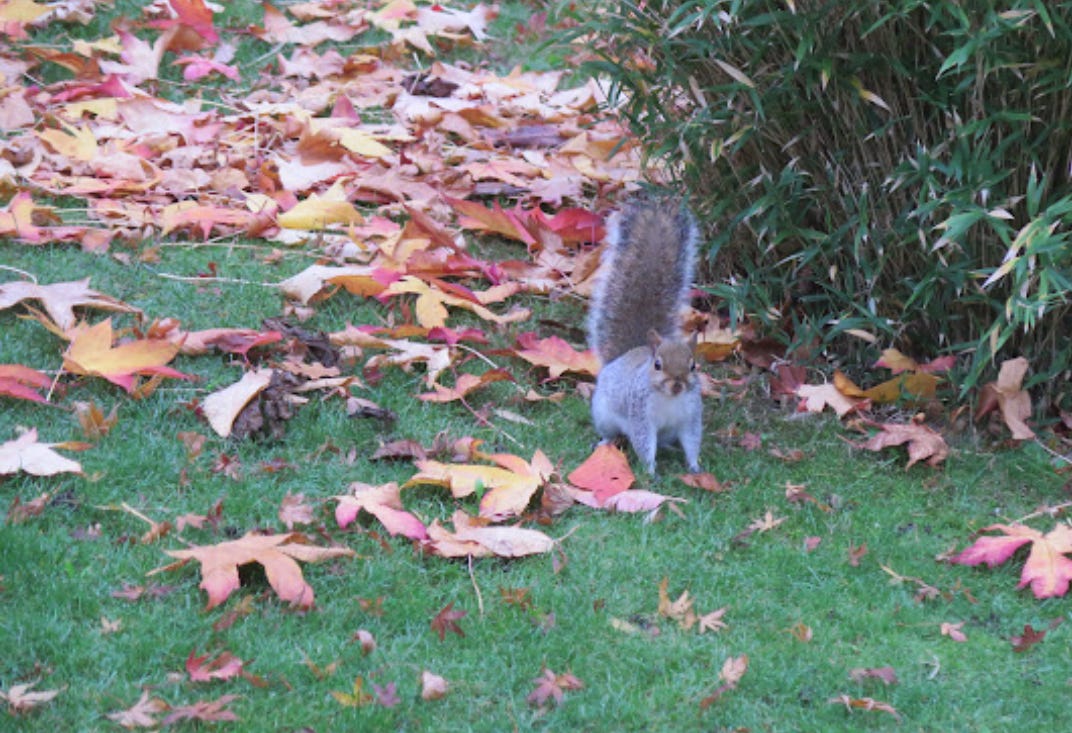
Still, I persist in trying to retain the same sense of wonder I feel when watching squirrels. They are, quite simply, phenomenal little animals. So consider this piece an act of public relations firefighting: a defence brief to counterbalance the ill words often spoken against them the next time you pause to watch one scurry past.
I will begin with the red squirrel, if only because it has seniority. The red squirrel, or iora rua as Gaeilge, has been present in Ireland since before the last Ice Age and is our only native squirrel species. It favours woodland habitats dominated by hazel, beech, and Scots pine, and remains one of the most charming inhabitants of the Irish landscape.
One of its more endearing features is the seasonal appearance of ear tufts, which grow long and pronounced in mid-winter before disappearing in summer. With a little practice, you can roughly guess the season the photo was taken based solely on how furry its ears are.
The red squirrel’s history in Ireland has not been an easy one. By the seventeenth century, it was close to extinction, largely due to widespread deforestation as Irish timber was extracted to fuel the British Empire. Much of today’s population can be traced back to reintroductions carried out in the nineteenth century. Encouragingly, red squirrels are now recorded in every county in Ireland, with sightings steadily increasing. They are even beginning to naturally recolonise areas where they were previously absent, including counties Meath and Louth.
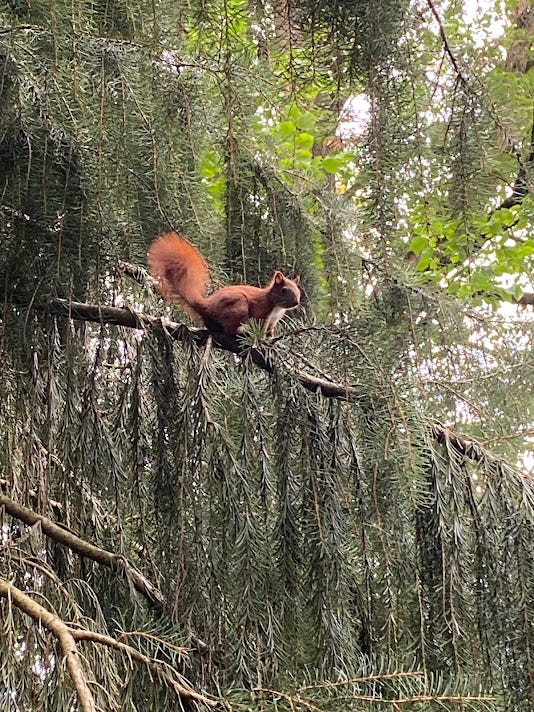
One particularly curious ecological detail is that grey squirrels have historically failed to establish populations west of the River Shannon. As a result, sightings west of the river are usually of red squirrels. I have always imagined this as a Watership Down-style standoff, with the Shannon serving as an impassable boundary between rival factions, though the reality is, I imagine, less fairytale-like.
The recent recovery of red squirrel populations has been linked to a decline in grey squirrel numbers. Grey squirrels compete directly with reds for food and carry squirrelpox virus, which is fatal to red squirrels but largely harmless to themselves.
Grey squirrels arrived in Ireland in the early twentieth century and quickly became established across the eastern half of the country. In addition to outcompeting red squirrels for resources and territory, they are known to dig up and consume food stores buried by red squirrels for winter survival.
Squirrelpox has been particularly devastating, compounded by new parasites introduced alongside grey squirrels. If this is beginning to sound like poor public relations for the grey squirrel, I should warn you: it does get worse. Grey squirrels also cause significant damage to woodlands by stripping bark from trees, particularly oak and beech, to access sap. This weakens tree stems, increases breakage, and poses a serious threat to woodland canopy structure.
That said, I am not here to prosecute the grey squirrel. Its population is now being naturally regulated by the resurgence of the pine marten or cat crainn.
Pine martens are identifiable by their dark brown fur, creamy throat “bib,” long bushy tail, and cat-like size. By the 1980s, they were close to extinction themselves, surviving primarily in woodlands west of the Shannon. The Wildlife Act of 1976, the banning of strychnine poisoning in the 1990s, and increased forestry cover have enabled a remarkable recovery. Today, pine martens are found in every county in Ireland. I would love to include a photo but I have yet to see one.
Their return has been associated with dramatic declines in grey squirrel populations, while red squirrels have benefited and begun to re-establish themselves.
There is also evidence that red squirrels are developing resistance to squirrelpox, offering further hope for their long-term survival. Meanwhile, conservation efforts have extended to the development of an oral contraceptive for grey squirrels, administered via bait, famously using Nutella, which may be the most memorable detail in this entire story.
So perhaps it is time to put down the hatchet. The grey squirrel may not be a villain so much as a victim of colonial circumstance: an adaptable, agile, chubby, fast little creature doing its best in an ecosystem it never asked to enter.
Ireland’s natural world is far from healed, yet the quiet re-emergence of the red squirrel and pine marten offers a cautious reminder that decline is not always permanent. With care, patience, and good policy, repair is possible, even if it takes a few decades and a great deal of Nutella.
For now, I will continue to appreciate squirrels, finding consistent joy in their presence among the trees.
Fascinating as always! I've heard the reason for the tandem resurgence of pine martin and red squirrel, is that the red squirrel is so light it can make it out to the very end of the branches and escape across the canopy, whereas the pine martin and grey squirrel can't follow so the pine martin selectively control grey squirrel populations🤯