Refusing to Begin
We will not be paying because solutions did not exist. Will pay because they were ignored.

The most frustrating thing about Ireland's climate crisis isn’t that we do not know what to do. It’s that we continue to elect politicians who know exactly what to do and refuse to even attempt it.
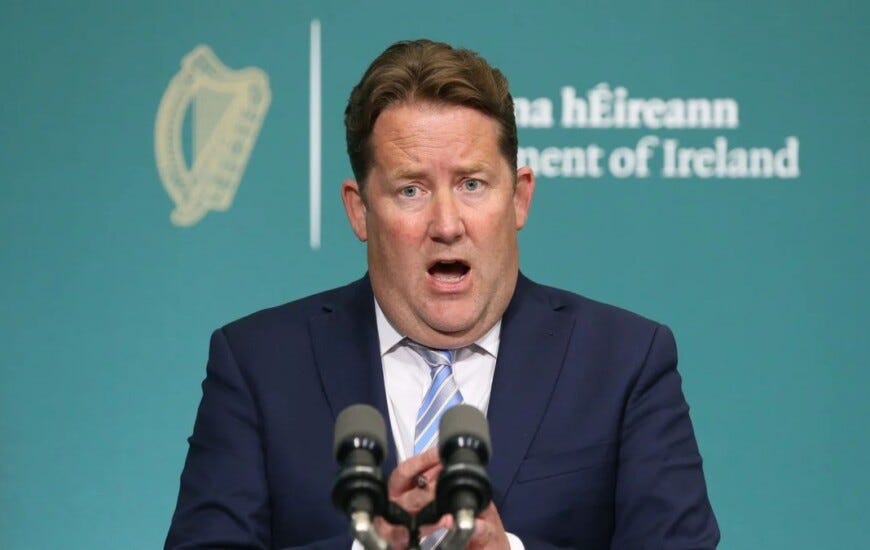
It was reported in The Irish Times that the Minister for Transport has effectively conceded that Ireland will not meet its legally binding climate targets.
After years of reports, plans, consultations and promises, we are now facing the possibility of spending billions on compliance measures because we failed to reduce emissions at the pace required.
The people who will pay the fine are the taxpayers. The same taxpayers whose government failed to act when the warnings were clear.
There is something deeply maddening about that reality. We are constantly told that public transport investment is too expensive. Climate action is unrealistic. Ambition is unaffordable. Yet somehow paying billions because we failed to do those things is not.
What makes it worse is that none of this arrived as a surprise.
The silence around climate action now feels like the calm before a thunderstorm, but in some ways the thunderstorm has already arrived.
We saw it during the fuel protests and the energy crisis. Yet even then, the conversation missed the central lesson. The problem was never climate action. The problem was dependence. Dependence on imported fossil fuels, on volatile international markets and on geopolitical events happening thousands of kilometres away that can suddenly dictate the cost of living in Ireland.
What made the response all the more frustrating was that even in the middle of that crisis, politics remained trapped in the logic of short-termism. Rather than using the moment to accelerate investment in public transport, renewable energy and energy security, the political instinct was to retreat.
The willingness to row back on carbon pricing was perhaps the clearest example of this. At precisely the moment when Ireland should have been having a serious conversation about reducing dependence on fossil fuels, the response was to make them cheaper.
It solved none of the underlying problems. It did not make Ireland less exposed to future price shocks. It did not reduce dependence on imported energy. It did not accelerate the transition that would ultimately protect households from volatile fossil fuel markets.
Faced with a crisis that exposed the dangers of fossil fuel dependence, our government had an opportunity to begin building something different. Instead, it postponed the conversation once again.
The scale of the crisis is enormous. Our biodiversity is in ruin; eighty-five per cent of protected habitats are now considered to be in unfavourable condition. More than fifty native bird species are of conservation concern. Water quality continues to deteriorate, with only around half of our surface waters now considered to be in satisfactory condition. The debate around the nitrates derogation reflects the same paralysis that characterises climate policy more broadly.
Perpetual uncertainty is not a strategy.
The country is getting richer, yet our politics seems increasingly incapable of doing what it was elected to do: confront long-term challenges and act on behalf of the people.
Transport decarbonisation, Minister O'Brien's other brief, is not some unsolvable puzzle. The All-Island Strategic Rail Review exists. The Climate Action Plan exists. We know how to reduce transport emissions and dependence on imported fossil fuels. We know how to build public transport systems that give people genuine alternatives to the private car. The plans are written. The evidence is there.
After five years of the Greens trying to get the machinery of climate action moving, it did not simply slow down when they left office. In many respects it appears to have been switched off entirely, gathering dust while we sink further into crisis.
The government has inherited plans and allowed momentum to dissipate while the opposition has struggled to articulate a competing vision with anything even approaching urgency.
Both Labour and the Social Democrats had the opportunity to enter government following the election and chose not to. That was their right. But opposition only has value if it offers a meaningful alternative. Instead, climate policy has largely drifted from the centre of political debate.
The result is a political system that treats climate policy as a failure to be managed rather than a pressing project to be pursued.
At a moment when Ireland is missing climate targets, facing potentially enormous costs and confronting interconnected crises in transport, biodiversity, food security, water quality and energy security, there should be fierce debate about competing visions for the future.
Instead there is a strange silence, as though everyone has quietly agreed to stop talking about the defining challenge of our time.
One of the most common arguments against meaningful investment is cost.
Legacy media loves reporting large figures. Perhaps that is because we are still living in the shadow of the National Children’s Hospital, a project that has become synonymous with spiralling sums and institutional failure and has still not opened.
We discuss infrastructure almost exclusively through the lens of what it costs rather than what it delivers.
But when was the last time you stood on a packed Red Line Luas and wondered how much it cost the State?
When was the last time you got on a DART and thought it should never have been built?
We only seem capable of seeing the cost before infrastructure exists. Once it becomes useful, once it becomes part of people’s daily lives and once entire communities depend upon it, the argument disappears. The media then moves to sparking outrage every time it is interrupted.
Which makes me wonder what the reaction will be if Ireland ends up paying billions in climate penalties.
Unlike a railway line, a tram network or a solar programme, climate penalties do not leave anything behind. They do not create energy security or restore biodiversity.
They do not connect communities, reduce emissions or improve quality of life.
They are simply the bill for failing to act.
We spend years agonising over the cost of infrastructure that might improve people’s lives for generations, yet seem remarkably relaxed about the prospect of spending vast sums on the consequences of not building it.
Nor is it true that change inevitably takes decades.
Look at what happened with rooftop solar. A technology that was barely visible a few years ago now sits on more than 155,000 rooftops across homes, farms and businesses. Solar capacity has surpassed 2GW nationally and on peak summer days supplies more than one fifth of Ireland’s electricity demand.
People respond when alternatives exist. The success of rooftop solar demonstrates that. The popularity of the Luas demonstrates that. The uptake of organics under incentives from the Green coalition demonstrates that. When governments create the conditions for change, people respond.
Yet as the climate crisis intensifies, those elected and entrusted with the mandate to act at scale retreat from the field.
That is not how this works.
Nobody can individually build a railway line, electrify a national rail network or can redesign a transport system around public need rather than car dependency. Those are collective projects. They require political leadership, public investment and governments willing to think beyond the next election cycle.
That is what politicians are elected to do.
It is impossible not to compare our stagnation to our European neighbour’s breakthroughs.
I always come back to Paris. Here was a city that decided to begin. It did not solve every problem overnight and many of the changes were controversial, but it chose movement over paralysis. It invested in cycling infrastructure, reduced car dominance and expanded alternatives. This didn’t happen because Parisians are uniquely enlightened, but because political leaders decided that paralysis was not an option.
Or Denmark, where long-term thinking around agriculture and land use has helped create more stable markets, improve food security and create opportunities for nature restoration at scale.
These places are not perfect. They simply recognised that the costs of inaction would eventually exceed the costs of change.
That, ultimately, is what feels absent from Irish politics today: the willingness to begin.
The purpose of government is not to preserve coalition arrangements, political dynasties or ministerial careers. It is not to spend years commissioning reviews only to leave them gathering dust. It is not to endlessly reassure the operators of data centres, multinational corporations and wealthy interests that everything will continue exactly as before.
It is to solve problems on behalf of the public.
We cannot continue to accept a country that has effectively stalled while the crises around it continue to accelerate.
The investment should be in our future.
The transition should be ours.
We are not facing climate fines because solutions did not exist.
We are facing them because those solutions were ignored.
The question is no longer whether we know what to do.
The question is why the people elected to do it refuse to begin.